
An ABM strategy is the set of decisions a sales and marketing team agrees before running plays for a named list of accounts. They run from which accounts to target to how the result is measured. The account list decides what every later step can achieve, and a list built on fit alone can still produce almost no meetings, whatever the budget behind it.
The usual advice lists the same pillars, from the ideal customer profile to measurement, without saying which to settle first or how the choice changes with the budget you have. This guide covers the 9 decisions in order, from choosing accounts to proving it worked, and how each changes from one marketer on $5k a month to a dedicated team.
How to build an ABM strategy
To build an ABM strategy, choose the accounts you can win and find out which of them are ready to buy. Then give each one an owner in sales, decide what each gets, and agree how you'll measure the result before anything launches.
ABM means account-based marketing, where sales and marketing work a named list of accounts together, with plays built for each account or group instead of a broad audience. We treat it as a run of decisions made in order, from who you can win to how pipeline is counted, because each choice narrows the next one. A list built before you know why buyers change holds the wrong accounts, and a play chosen before sales agrees to the list reaches accounts nobody calls. The fit list can come first, but the core list of accounts with a reason to buy now waits until you know why buyers change.
The common start is the tools and the ads. Both should come last, once the list, its owners and the test are settled.
We call the sequence the 9 decisions, and nothing launches until all 9 are made. The table sets out each one, the options, the first pick for a program around $10k a month, and what changes as the budget grows.
| # | Decision | Options | First pick | With more budget |
|---|---|---|---|---|
| 1 | Define who you can win | Market data, or your own closed-won deals | Your last 20 closed-won deals and what they share | Bought firmographic and technographic data to find more accounts like them |
| 2 | Build and qualify the account list | Buy a list, build it from your CRM, or both | Build it from your CRM and closed-won deals | Buy data to fill gaps the CRM can't |
| 3 | Learn why buyers would change | Your own guess, or what buyers tell you | 5 short calls with recent wins and lost deals | Regular buyer interviews, run by someone who owns them |
| 4 | Separate fit from timing | One list on fit, or a fit list plus a core list on timing | A fit list, and a core list of accounts showing a reason to buy now, picked with the sales lead | A paid intent data source on top of your own signals |
| 5 | Map the buying group | One contact, or several roles | 3 roles per account, the user, the budget owner and whoever could block it | More roles, and plays for each |
| 6 | Connect first-party signals | Your own signals, or bought intent data | Your own signals, routed into the CRM | A platform that joins site, product and ad signals |
| 7 | Match the play to the account | 1:1, 1:few or 1:many | 1:many on the fit list, 1:few for the core list | 1:1 for a small top tier |
| 8 | Give every action an owner | Marketing, sales or both | A named rep per account and a weekly review | A dedicated ABM owner beside the reps |
| 9 | Measure pipeline impact | Influenced pipeline, or a holdout test | A random holdout from the fit list, drawn before the core list | The same test, because budget doesn't change how ABM proves itself |
Your own deals beat market data for decision 1, because they show which accounts actually buy from you, while market data shows only who could. For decision 2, a bought list is faster but matches on size and industry with no sign of pain or timing. So build from the CRM and buy data only to fill gaps.
Budget changes how each decision is made, not the order. A program at $5k a month and one at $100k a month are different programs, not one program scaled down.
How to choose target accounts for ABM
Choose target accounts on fit, pain and timing, and keep fit and timing on separate lists. Fit says whether a company could buy from you, and pain and timing say whether it has a reason to change now.
Firmographics plus intent data feel like enough, but they only narrow the list. Account selection starts from psychographic fit, which asks whether a company has the pain you solve. SPICED (opens in a new tab), the framework from Winning by Design, gives the lens we use: the situation, the pain, its impact, the critical event and how the decision gets made. An account with a clear pain and a critical event is ready to change, while a perfect match on size and industry with neither goes quiet.
Timing matters because buyers decide who's in the running before they talk to anyone. In its 2025 B2B Buyer Experience Report (opens in a new tab), based on nearly 4,000 buyer responses, 6sense found that buyers first contact a vendor 61% of the way through their buying process. The winning vendor was already on the buyer's day-one shortlist 95% of the time. So the core list has to catch accounts while buyers are still ranking that shortlist, and the fit list keeps you known before day one.
61%
of the way through their buying process, buyers first contact a vendor
6sense, 2025 B2B Buyer Experience Report (nearly 4,000 buyer responses)
95%
of the time, the winning vendor was already on the buyer's day-one shortlist
6sense, 2025 B2B Buyer Experience Report (nearly 4,000 buyer responses)
Your target account list is the named accounts a program works, chosen on fit, checked for timing and agreed with sales before anything launches. Fit and timing are separate questions, so they belong on separate lists. Take a hypothetical case. A company selling sales software that builds a fit list of 400 companies from its closed-won deals, matched on size, industry and tech stack.
With one list, ads and sequences reach all 400, and nearly all of them have no reason to change in a given quarter. With 2 lists, the fit list stays for reach, and a core list holds the 60 or so accounts showing a timing signal the team can see itself.
For a company like that, the signals worth watching look like this.
- A new sales leader at the account
- A hiring spree in the sales team
- A trial that went quiet
- 2 or more people from one company on the pricing page
Your own signals will differ, so find them from your deals and buyers.
- Pull your last 20 closed-won deals and look at what happened in the month before each one opened, because that's when the reason to buy showed.
- Make 5 short calls with recent wins and lost deals, so the pain and the critical event come from buyers rather than your own guess.
- Pick 3 or 4 signals that show up in both and that you can see for any account.
With fewer than 20 closed-won deals, use every deal you have and lean harder on the calls.
Before you build the core list, set aside 1 in 5 fit accounts at random as a holdout. Drawn first, it keeps its share of accounts that would have made the core list, so the comparison stays fair. The holdout is how you'll show what the program added, so its accounts never join the core list, even when they show a signal.
How to get sales to work the account list
To get sales to work the account list, have the sales lead pick the core accounts with you before anything launches. Then give every account a named owner for its next step, usually a rep, and review the accounts that moved each week.
Marketing can warm an account, but a rep turns interest into a meeting. The common setup has marketing run ABM and pass on warm accounts, and it fails in a predictable way. Reps keep prospecting their own territories, engagement looks healthy in the dashboard, and the plays reach accounts nobody calls.
So the list belongs to sales before it belongs to marketing. The sales lead agrees to the signals that put an account on the core list. New accounts that meet them join at the weekly review, which takes about 30 minutes.
A rep working an account needs more than one contact there, because ABM sells to a buying group. A buying group is the people at one account who decide a purchase together. Typically it's the person who'll use the product, the one who owns the budget and the one who could block it. A play that reaches only the user stalls when the budget owner hears about it last.
Which accounts should get 1:1, 1:few or 1:many?
1:1 is for the few deals where a small lift in the win rate covers the cost of the play. Our guide to one-to-one ABM shows how to choose them. Accounts that share a trigger go into 1:few groups, and the fit list runs as 1:many.
| Tier | What it means | Accounts | Best when |
|---|---|---|---|
| 1:1 | Plays and content built for a single account | A handful | A small lift in win rate covers the play |
| 1:few | One play built for a group of 5 to 15 accounts that share a trigger or a problem | 5 to 15 per group | Several accounts share a trigger |
| 1:many | Existing programs, such as ads and email, aimed at the whole target list rather than tailored to each account | The fit list | You need reach and the deals are smaller |
LinkedIn's help page on company list targeting (opens in a new tab) says an uploaded list must have at least 300 rows, and the audience can take up to 48 hours to build. A core list under 300 companies can't run as its own uploaded audience.
Even without an upload, LinkedIn's targeting options (opens in a new tab) require an audience of at least 300 members for every ad set. Narrowed to the 3 roles of each buying group, a 1:few group of 5 to 15 accounts holds far fewer people than that. So it gets outreach and content rather than its own ad set.
Run the 1:many ads on the fit list, minus the holdout, so you're known before day one. With the holdout set aside, a fit list needs about 375 companies to stay above the 300-row minimum. Give the core accounts 1:few plays, with sales outreach and content built for the trigger they share.
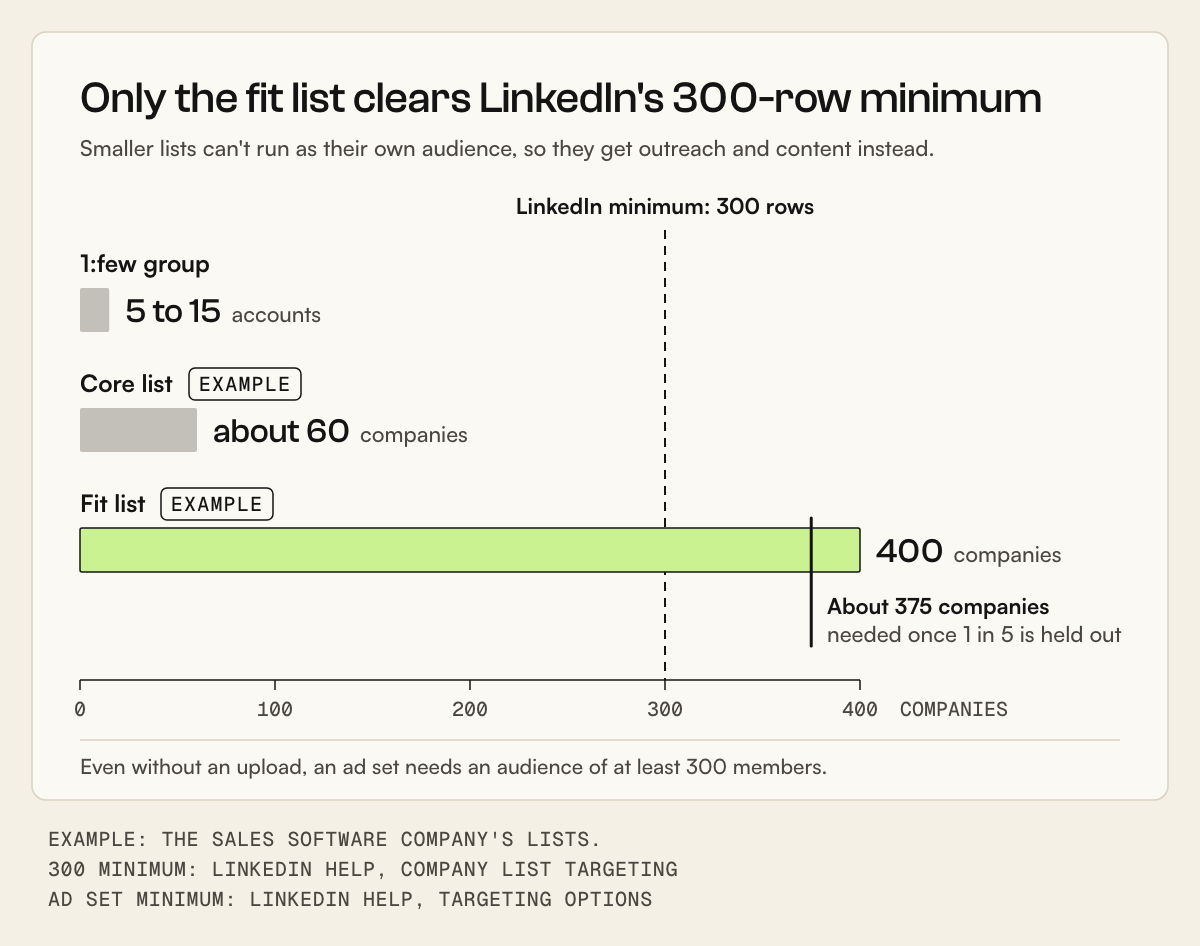
Why 1:many ads run on the fit list while core accounts get outreach and content. Minimums from LinkedIn Help: company list targeting (opens in a new tab) and targeting options (opens in a new tab); list sizes are the article's example.
Group the core list by timing signal rather than by industry, because accounts that just hired a sales leader share a problem, while accounts in one industry may not. Split any group past 15 accounts. For example, the group whose trial went quiet could get a short note from its rep and a setup guide aimed at the step where trials stall.
How does ABM change with budget and team size?
With each step up in budget, ABM adds a tier of play or a source of data, and the team grows to run it. The range starts at $5k a month. The monthly budget is program spend on media, content, tools and mail. The people who run it, in the last column, are on top of that.
These tiers are our starting point, not a benchmark, so adjust them to your deal size and how many accounts sales can work. Below $5k a month, ABM isn't smaller, it's narrower. It runs on the data you already own, such as the accounts your website shows paying attention, so the budget goes into acting on those signals rather than buying them.
| Monthly budget | Program shape | Where the money goes | Leave out for now | Who runs it |
|---|---|---|---|---|
| $5k | 1:many on one tightly chosen list | LinkedIn ads and retargeting, with accounts researched manually | Intent platforms, direct mail, 1:1 pages | One marketer, with an hour of the sales lead's time each week |
| $10k | 1:many, plus 1:few plays for the best-fit group | Landing pages tailored to each group | Platform contracts | 2 marketers, or 1 with sales running the 1:few outreach |
| $20k | Tiered, with 1:few for the top group and 1:many for the rest | A paid intent data source on top of fit | 1:1 for more than a handful of accounts | 2 or 3 marketers, with content or ops support |
| $50k | 1:1 for a small top tier | An ABM platform, or direct mail for the top tier | 1:1 beyond the top tier | A small team with an ops owner |
| $100k and up | All 3 tiers, with a dedicated owner | Platform, 1:1 content, events and direct mail | Spreading 1:1 wider than sales can follow up | A dedicated ABM team with reps assigned to accounts |
Take the sales software company with 400 fit accounts and 60 core ones. At $5k, one marketer runs LinkedIn ads to one list, the fit list, and researches the 60 core accounts manually for sales to work. At $50k, it adds an ABM platform or direct mail, and 1:1 plays for a small top tier of the 60. At $100k, the risk shifts to spreading 1:1 wider than sales can follow up.
The mistake at the low end is running a big program's playbook on a small budget. Spread across every tier and channel, the budget leaves each one too little to work, so pick fewer accounts, fewer tiers and one channel done well. Team size sets a limit of its own, because 1:few and 1:1 plays need people as well as budget. One marketer with a large budget should still run 1:many on one list and the weekly review, and leave out 1:1 plays, platform contracts and direct mail.
What tools do you need for ABM?
At any budget, ABM needs a CRM, an ad platform that targets a list of companies, and a way to see which target accounts visit your site. You don't need an ABM platform to start, because a platform automates a process that isn't there until the list and its owners exist.
The CRM holds the list, the owners and the weekly review, so it's the tool everything else is built around. Visits come from a tool that matches web traffic to companies by their IP address, and trial activity comes from your product. Job changes and hiring sprees show on LinkedIn and job boards. Route all of it into the CRM, so a timing signal reaches the rep who owns the account.
IP matching misses people working from home, so treat a visit as a reason to look closer rather than as proof. In our view, a paid intent data source earns its place around $20k a month, on top of fit. An ABM platform pays for itself around $50k, once moving lists between tools manually costs more than the platform does.
How to measure whether ABM worked
Measure ABM by comparing the fit list with a random holdout from the same list, because influenced pipeline can't tell you what would have happened anyway.
Influenced pipeline counts every opportunity opened by a target account after it saw a play. It's the common proof, and finance discounts it, because it includes deals that would have opened anyway. A holdout shows what the program added, and it ties ABM to pipeline created, the number every channel answers to.
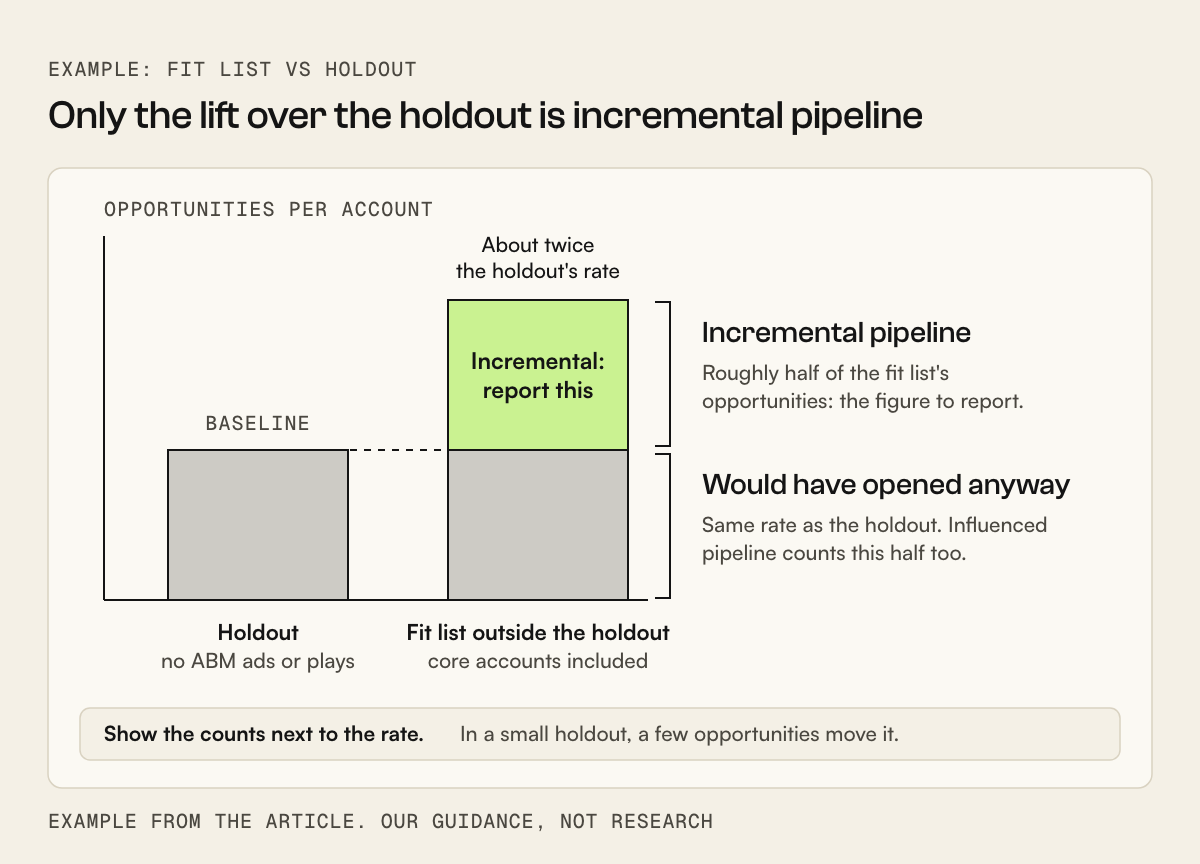
The holdout is the 1 in 5 fit accounts drawn at random before the core list, and it stays on business as usual. That means no ABM ads or plays, while reps still handle inbound and their normal prospecting. If reps ignored those accounts, the holdout would do worse and the lift would look bigger than it is.
Compare every fit account outside the holdout, core accounts included, with the holdout. The core list alone can't be compared with a random group, because it was chosen for its timing signal.
Each quarter, run our pipeline report skill on each group's deals to get its opportunity count. Divide each count by the accounts in that group and compare the 2 rates. If the fit list opens opportunities at about twice the holdout's rate, roughly half of its opportunities are incremental pipeline, and that half is the figure to report. In a small holdout, a few opportunities move the rate, so show the counts next to it, and see the stop rules below for a holdout too small to read.
How long does ABM take to show results?
ABM takes about a month to set up, a full quarter of plays before meetings and pipeline are worth reading, and a full sales cycle before revenue shows.
- In month 1, build the fit list, draw the holdout, agree on the core list with sales and set the stop rules. Upload the fit list without the holdout as soon as it's drawn, because LinkedIn can take up to 48 hours to build the audience.
- In months 2 to 4, run the plays and hold the weekly review of the accounts that moved.
- After a full sales cycle, compare the 2 groups and decide what grows.
The first meetings from the core list should come within that first quarter of plays. With a 90-day sales cycle, the first real review comes about 4 months after you start. A bigger budget doesn't shorten this, because the sales cycle sets the pace, not the spend.
When to shrink or stop an ABM program
An ABM program should shrink when fewer accounts join the core list each month than drop off it. An account drops off when its signal goes cold, not when it opens a deal. The program should stop when the fit list opens opportunities no faster than the holdout for a full sales cycle. Agree on these rules with sales and finance up front, so the call isn't made under pressure later.
A third rule, agreed at the same time, keeps sales on the list. When fewer than half the core accounts have had a rep touch them in the last month, agree on the list with sales again.
Shrinking means cutting the core list back to the accounts still showing a signal, or dropping a budget tier, while the 1:many ads and the holdout keep running. Stopping means ending the spend and keeping the list and its owners in the CRM.
If the holdout would open only a few opportunities in a sales cycle, the stop rule can't rest on it, because the rate moves too much to read. Compare the fit list with its own quarter before launch instead, and treat a flat result as a reason to shrink rather than to stop.
| When | What we'd do |
|---|---|
| Fewer accounts join the core list each month than drop off it. An account drops off when its signal goes cold, not when it opens a deal. | Shrink: cut the core list back to the accounts still showing a signal, or drop a budget tier, while the 1:many ads and the holdout keep running. |
| The fit list opens opportunities no faster than the holdout for a full sales cycle. | Stop: end the spend and keep the list and its owners in the CRM. |
| Fewer than half the core accounts have had a rep touch them in the last month. | Agree on the list with sales again. |
| The holdout would open only a few opportunities in a sales cycle. | Compare the fit list with its own quarter before launch instead, and treat a flat result as a reason to shrink rather than to stop. |
Where to start
Settle the list, its owner in sales and the holdout before the first ad runs. Once those are set, and if you'd rather not run the LinkedIn side yourself, here's how we run LinkedIn Ads. Whichever route you take, the first step is to pull your last 20 closed-won deals and look at the month before each one opened. That pattern is your first timing signal, and it comes from your own customers.
Sources
Every figure in this post links to where it comes from. These are the pages we checked.
- 01SPICED · winningbydesign.com
- 022025 B2B Buyer Experience Report · 6sense.com
- 03LinkedIn's help page on company list targeting · linkedin.com
- 04LinkedIn's targeting options · linkedin.com
