
One-to-one ABM (also called strategic ABM) is account-based marketing where research, content and outreach are built for a single named account. Once a target list exists, every account on it competes for the same budget and the same reps' time. So 1:1 only pays off on the few accounts with a dated reason to buy and a deal big enough to cover the work. Give it to the wrong accounts and the money is gone before the accounts ready to buy hear from you.
The usual split gives 1:1 to the biggest logos, the ones sales asks for, and 1:many to the rest. That sorts accounts by size and ignores whether they have a reason to buy now. This guide defines the 3 tiers and gives a rule for placing each account. It then shows the plays, cost per account and team each tier needs, from one marketer on $5k a month to a dedicated team on $100k and up.
How is one-to-one ABM different from 1:few and 1:many?
The difference between 1:1, 1:few and 1:many ABM is how many accounts share each play. It's one account, a group of 5 to 15 that share a trigger or a problem, or the whole target list. One-to-one is kept for the few deals where a small lift in the win rate covers the cost.
ABM means account-based marketing, where sales and marketing work a named list of accounts together, with plays built for each account or group instead of a broad audience. The target account list is the named accounts a program works, chosen on fit, checked for timing and agreed with sales before anything launches. We split it into a fit list, every account that could buy, and a core list, the ones showing a reason to buy now. The 3 types of ABM then split that list by how much gets built for each account.
The tiers go by other names too. One-to-one ABM is often called strategic ABM, one-to-few ABM is called ABM lite, and one-to-many ABM is called programmatic ABM. Placing each account in a tier is called account tiering, and it sets where the budget and the reps' time go.
| Tier | Also called | What it means | Accounts | Who owns the next step | Best when |
|---|---|---|---|---|---|
| 1:1 | Strategic ABM | Plays and content built for a single account | A handful, as many as reps can work every week | The account's rep, with a marketer building for that account alone | A small lift in the win rate covers the play |
| 1:few | ABM lite | One play built for a group of 5 to 15 accounts that share a trigger or a problem | 5 to 15 per group | The reps who own the group's accounts | Several accounts share a trigger |
| 1:many | Programmatic ABM | Existing programs, such as ads and email, aimed at the whole target list rather than tailored to each account | The whole fit list, apart from a holdout | The territory rep, who reaches out to accounts that respond | Every account, as the base layer, and the only tier for accounts with no reason to buy yet |
One-to-one ABM is closer to running a small campaign for one account than to changing the name in an ad. The work starts with research on the account, such as its goals, its buying group and the event that makes this quarter different. The rep and a marketer then agree on an account plan. The marketer builds content for that account alone, such as a business case built on its own figures.
A buying group is the people at one account who decide a purchase together. Typically it's the person who'll use the product, the one who owns the budget and the one who could block it. When those people sit in separate departments with different worries, one group message reaches only some of them.
We put 1:many under every fit account, with 1:few and 1:1 on top for the core accounts that earn them. The one exception is a random holdout, kept back to measure the program. So the tiers aren't 3 separate programs. They're 3 depths of attention, and an account can move between them as its situation changes.
1:1 ABM fails when it's spread across more accounts than sales can follow up. The content gets built and nobody books the meeting. That's why the tier is set by the deal's economics and a rep's time, not by how well known the logo is.
Which tier should each account get?
Each account's tier should follow its pain, its timing and what the deal is worth, not the size of its logo. An account with no visible reason to buy stays in 1:many. 1:1 is kept for large deals a rep will work every week, and accounts that share a trigger form 1:few groups.
The common way to tier is by firmographics, with the biggest companies in 1:1 and an intent spike as the reason to promote one. Firmographics plus intent data feel like enough, but they only narrow the list. An intent spike shows that someone at the account is researching a topic, which isn't the same as having the pain or a deadline. A famous logo with neither soaks up a 1:1 budget and goes quiet, while a smaller account with a deadline gets nothing built for it.
Account selection starts from psychographic fit, which asks whether a company has the pain you solve. Timing is a separate question, whether it has a reason to act now. SPICED (opens in a new tab), the framework from Winning by Design, gives the lens we use to place accounts. Its 5 parts are the situation, the pain, its impact, the critical event and how the decision gets made.
Pain and the critical event decide whether an account leaves 1:many at all. Impact and the decision decide how far up it goes. A costly problem supports a larger deal. A decision spread across departments needs a case for each of them, built on the account's own figures, which only 1:1 can afford to build.
Forrester's State of Business Buying, 2026 (opens in a new tab) found the typical buying decision now includes 13 internal stakeholders and 9 external influencers, with that number rising for more complex or strategic purchases. So every account has a buying group worth mapping, and the group grows as the purchase gets more complex. What marks a 1:1 account is a complex or strategic purchase, where finance, IT and procurement each need a case built on the account's own figures.
9
external influencers too, with the number rising for more complex or strategic purchases
We place each account with 4 questions, asked in order.
- Does it fit, and can you name its pain? Every fit account outside the holdout starts in 1:many, and one whose pain you can't name stays there.
- Does it have a critical event, a dated reason to act such as a new leader or a contract ending? Only then does it join the core list, where the next 2 questions apply.
- Is the likely deal large enough that a small lift in its chance of closing covers a play of its own? It also needs a complex or strategic purchase, where several departments each need their own case, and a rep who has agreed to work it every week. Only with all 3 does it get 1:1.
- If it doesn't get 1:1, does it share its trigger or problem with at least 4 other core accounts? Then it joins a 1:few group built around that trigger.
A core account that gets neither stays in 1:many, and its rep works it directly. Questions 3 and 4 also depend on the budget, which sets how many accounts each tier can carry.
When should you use 1:many ABM?
Use 1:many ABM as the base layer for every fit account outside the holdout, and as the only tier for accounts that show no reason to buy yet. It's also the whole program when the budget is around $5k a month or one marketer runs ABM.
Fit and timing are separate questions. A list of good-fit accounts with no trigger goes quiet in 1:few or 1:1, because nothing at those accounts makes this quarter the time to act. 1:many keeps them aware of you at a low cost per account while you watch for the signal that moves them up.
A fair objection is that 1:many is demand gen with a list. The difference is the list and who acts when an account responds. Demand gen programs usually take leads from any company that responds, while 1:many ABM aims only at named accounts. Each one has a named rep before the first ad runs, who reaches out when 2 or more of its known contacts engage with the emails or the site.
On LinkedIn, the 1:many layer can run as an uploaded company list. LinkedIn's help page on company list targeting (opens in a new tab) says a list needs at least 300 rows to upload and 300 matched LinkedIn member accounts to run in an active ad set. The same page recommends 1,000 or more companies, so treat 300 as the floor rather than the target. The audience can take up to 48 hours to build, so upload the list a few days before launch.
How many accounts belong in each ABM tier?
Each ABM tier holds as many accounts as you can work at its depth. 1:1 holds only what your reps can work every week, usually a handful. 1:few runs in groups of 5 to 15 that share a trigger, and 1:many covers the fit list outside the holdout.
Size each tier from your own capacity rather than a published benchmark, because capacity is what limits it. For 1:1, the limit is the reps. Marketing can warm an account, but a rep turns interest into a meeting. So every account has a named owner for its next step, and that owner is usually in sales.
A 1:1 account with no rep behind it gets a business case that never reaches a meeting. Count the reps who will work an account plan every week and how many such accounts each can carry beside their own pipeline. Below $50k a month, the budget caps 1:1 at a handful of accounts or fewer, whatever the reps can carry. When sales asks for 1:1 on its 30 biggest logos, ask which rep will work each one every week, and place the rest by pain and timing instead.
For 1:few, the group size sets itself. Below 5 accounts, the play's build cost is split too few ways to beat a rep working each account directly. Above 15, one landing page and one guide fit each account less well, so split the group by industry.
For 1:many, the tier is every fit account outside the holdout, core accounts included, because the ads keep running underneath the 1:few and 1:1 plays.
Take a hypothetical case. A SaaS company selling expense software to mid-market companies, with a fit list of 500 accounts. Before anything else, it sets aside 100 of them at random as a holdout to measure the program, which leaves 400 in play. About 40 of those 400 show a reason to buy now, such as a new CFO or an expansion into a second country.
Of those 40, the 3 that get 1:1 have large likely deals, purchases that span finance, IT and procurement, and a committed rep. The rest form 3 or 4 groups for 1:few, one for each trigger, and all 400 accounts in play sit in 1:many.
What does each tier cost per account against the deal value?
A tier's cost per account is what it adds on top of the tier below, people's time included, for as long as the account sits in it. The tier pays off when that extra cost is smaller than the likely deal value multiplied by the extra lift it adds to the account's chance of becoming a customer.
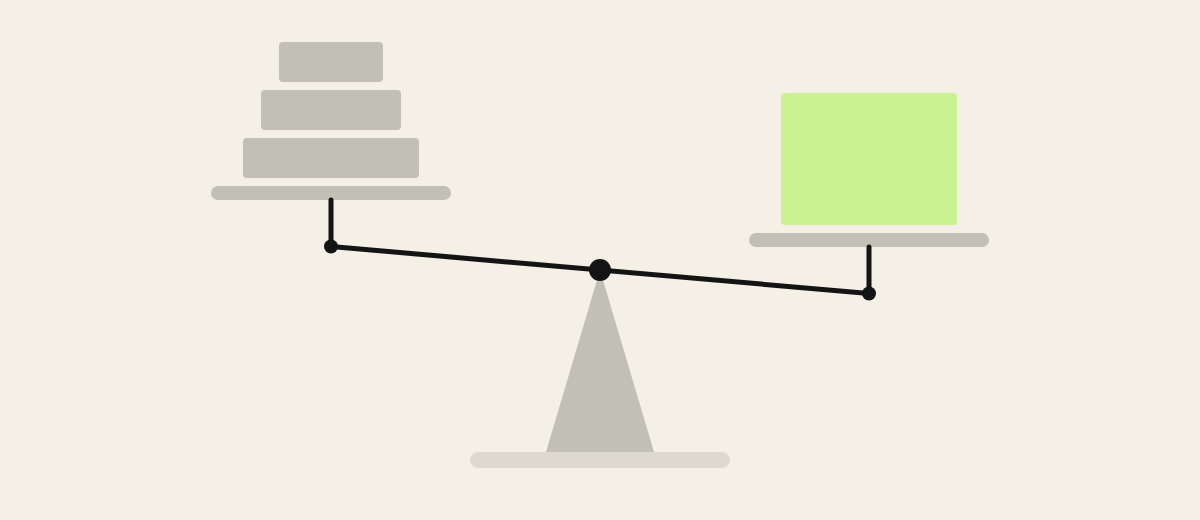
Only the extra counts, because every core account also gets the 1:many ads and its rep's normal selling. For 1:1, the extra is the marketer's research and build, the content and direct mail, and the rep's time on the account plan beyond normal selling. Count it over the whole stay, which for 1:1 is the whole sales cycle, not one quarter.
That gives a quick test for any tier. Divide the extra cost per account by the likely deal value, and the result is the lift the tier needs to break even. Use one deal value throughout, such as the likely first-year contract value, so every tier is tested against the same figure.
The starting chance shows whether that lift is realistic. Before a deal opens, an account's chance of becoming a customer sits below your opportunity win rate. Estimate it as the share of similar fit accounts that opened an opportunity last cycle, times that win rate.
As a rule of thumb, a 5-point lift on a chance of 1 in 10 turns every 10 wins into 15, which is a lot to ask of one play. On 4 in 10, the same 5 points turn 40 wins into 45, so the lift is easier to believe.
Run the expense software company through the test, with each cost as a share of one likely deal's first-year value. Say the extra for one 1:1 account, people's time included, comes to a twentieth of its likely deal over the cycle. That account then needs at least 5 more points of chance to close.
To keep the figures simple, say each of the 3 already has an open opportunity, so it starts at the company's win rate, near 3 in 10. An account without one starts lower. 5 more points turn 30 wins into 35, and the team believes a plan built for each account can add that. If it needed 10 points, the 3 accounts would go to 1:few instead.
Now take a 1:few play for a group of 10 accounts that hired a new CFO. Its page, its guide and the reps' outreach together cost about what one 1:1 plan does. Split across 10 accounts, each needs only about half a point of lift on a deal of the same size, or a point on one half as large. The 1:many ads cost less again per account, which is why they can run under every account in play.
| Tier | What the extra cost per account covers | Accounts sharing it | Deal value it needs |
|---|---|---|---|
| 1:1 | Research, an account plan, content built for one account, direct mail, and the rep's plan time over the whole sales cycle | One | Large enough that a few more points of chance to close cover all of it |
| 1:few | One play built for the group, plus outreach written for its trigger | 5 to 15 | Mid-size, since the build cost is split across the group |
| 1:many | Ad spend and email spread across the list | The whole fit list | Smaller deals work, since the cost per account is small |
The test also rules out 1:1 for small deals, because no realistic lift covers the play, whatever the logo.
What plays fit each tier?
The plays that fit each tier follow from what its accounts have in common. 1:many plays carry one message across the whole list, and 1:few plays answer a trigger the group shares. 1:1 plays are built around one account's buying group and its critical event.
Take the expense software company again, with its fit list of 500 mid-market accounts. Every play below has a named owner for its next step, and in every tier that owner is a rep.
In 1:many, the company runs LinkedIn ads to the 400 accounts outside the holdout, with one message about a problem every finance team shares, such as month-end close. Email goes to known contacts at those accounts. Marketing owns the ads, and the CRM alerts each account's rep when 2 or more known contacts from it click an email or visit the site.
The 1:few groups form around triggers the company can see. One group holds 10 accounts that hired a new CFO in the last quarter, and another holds 8 that opened an office in a second country. The new-CFO group gets a landing page and a short guide on what a new CFO checks first in expense policy, and its reps send outreach that names the hire. Marketing builds the page once, and the reps who own the 10 accounts own the follow-up.
1:1 goes to the 3 accounts with the largest likely deals, each with a rep who has agreed to an account plan. For one of them, the marketer spends the first 2 weeks estimating what its current expense process costs, from its headcount, its finance team and its job posts. The business case is built on that estimate, and the rep checks the figures in the first meeting. The rep then books a meeting with each department in the buying group, such as finance, IT and the travel team, with the case cut for each.
The business case isn't the only 1:1 play that earns its cost. 3 more fit the same account plan, each aimed at a role in the buying group rather than the logo.
- A note or short video to the budget owner that opens with their own figure, such as the estimated cost of their month-end close, not a product pitch. The figure is about their own business, so it's hard to wave away.
- A working session with the finance team, run by the rep and the marketer, that walks through the case using the account's data. It beats a webinar invite because it replaces a meeting the rep needed to book anyway.
- Direct mail sent after a meeting, not before. To a cold contact it's a gift with no context. To someone who has just seen the business case, it's a reminder with a reason.
One play we'd usually skip at this tier is a landing page per account with the logo swapped in. It costs a build, and the meeting comes from the business case, not the page.
Forrester's State of Business Buying, 2026 (opens in a new tab) also found procurement professionals were decision-makers in 53% of business buying cycles, engaging from the start of the process. So the rep sends procurement its security and contract answers early.
Ads still help a 1:1 account, but only in the background. An ad set aimed at one large company can clear LinkedIn's 300-member minimum, but one narrowed to its buying group falls far short. So the 1:1 work happens in meetings, with the ads in the background.
How much time and budget does each tier need?
1:1 needs research up front, then a rep's work every week for the whole sales cycle. It starts at $20k a month with a handful of accounts, and grows into a top tier with direct mail or a platform at $50k. 1:few needs one build per group and the reps' follow-up, from $10k. 1:many needs one marketer to run the ads and email, from about $5k.
For 1:1, the research and the business case take about 2 weeks per account in the hypothetical case, before the first touch. After that, the rep works the account every week, and the plan's milestones get a monthly check. Plan 1:1 in people rather than hours.
A program at $5k a month and one at $100k a month are different programs, not one program scaled down.
These tiers are our recommended starting points and not benchmarks. Adjust them to your deal size and sales cycle. The monthly budget is program spend on media, content, tools and mail. The people who run it, in the last column, are on top of that.
| Monthly budget | Tier mix | Where the money goes | Leave out for now | Who runs it |
|---|---|---|---|---|
| $5k | 1:many on one tightly chosen list | LinkedIn ads and retargeting, with accounts researched manually | Intent platforms, direct mail, 1:1 pages | One marketer, with an hour of the sales lead's time each week |
| $10k | 1:many, plus 1:few plays for the largest trigger group | Landing pages tailored to each group | Platform contracts | 2 marketers, or 1 with sales running the 1:few outreach |
| $20k | Tiered, with 1:few for the 2 or 3 largest trigger groups, 1:many for the rest and a handful of 1:1 accounts | A paid intent data source on top of fit | 1:1 for more than a handful of accounts | 2 or 3 marketers, with content or ops support |
| $50k | 1:1 for a small top tier, on top of 1:few and 1:many | An ABM platform, or direct mail for the top tier | 1:1 beyond the top tier | A small team with an ops owner |
| $100k and up | All 3 tiers, with a dedicated owner | Platform, 1:1 content, events and direct mail | Spreading 1:1 wider than sales can follow up | A dedicated ABM team with reps assigned to accounts |
Below $5k a month, ABM isn't smaller, it's narrower, with 1:many on data you already own and no paid 1:1. Your website shows which accounts are paying attention and what they care about, so the budget goes into acting on those signals, not buying intent data.
The expense software company runs 3 or 4 groups in 1:few and 3 accounts in 1:1 with direct mail. That mix sits on the $50k row, where a small team with an ops owner runs it.
At $20k, it would keep 1:few for its 2 or 3 largest trigger groups and move the rest back to 1:many. Its 3 accounts could stay in 1:1 without direct mail or a platform. It would keep paid intent data on top of fit, as a prompt for the rep to check for a critical event.
At $5k, it would cut the list to the accounts whose pain it can name, keeping enough that 300 remain after the holdout for a LinkedIn upload. That's below LinkedIn's recommended 1,000 on purpose, because a small budget spread across a long list reaches each account too rarely to matter.
The mistake at the low end is running a $100k playbook on a $10k budget. Spread across every tier and channel, each one gets too little to work, so pick fewer accounts, fewer tiers and one channel done well. At $100k and up, the budget stops being the limit, and the mistake is spreading 1:1 wider than sales can follow up.
When should an account move up or down a tier?
An account should move up a tier when it shows a critical event and its owner in sales agrees, and move down when that signal goes cold.
The signals that move an account up are critical events, and they come from your own deals. For the expense software company, they look like this.
- A new leader in a buying group role, such as a new CFO
- A funding round, an acquisition or an expansion into a second country
- A contract with its current provider coming up for renewal
Engagement works differently. A trial that went quiet, or 2 or more known contacts on the pricing page in a week, shows research rather than a reason to act. Like paid intent data, it prompts the rep to look for the critical event, and the account moves only when the rep finds one.
Our buying moments skill finds these moments in your won and lost deals, so the signals come from your buyers rather than a guess.
| When the account shows | What to do |
|---|---|
| A critical event, such as a new CFO, a funding round or a contract coming up for renewal | Move it up a tier once its owner in sales agrees |
| Engagement, such as a trial that went quiet or 2 or more known contacts on the pricing page in a week | Keep it where it is. The rep looks for the critical event, and the account moves only when the rep finds one |
| A deal that grows, such as a project that widens from one team to the whole company | Move it from 1:few to 1:1 once a rep agrees to an account plan. Another 1:1 account usually moves down |
| A signal gone cold: the buying group stops responding for a full quarter, or the project behind the critical event is shelved | Move it down a tier |
| A 1:1 plan that hasn't moved in a full sales cycle | Drop it, and the next account in line takes its place |
| An open deal | Keep it, because the deal is what the tier was for. A won account moves to your customer program, and a lost one returns to 1:many until a new signal shows |
Moving from 1:few to 1:1 takes more than a signal. The deal has to grow, such as a project that widens from one team to the whole company, and a rep has to agree to an account plan. 1:1 has a fixed capacity, set by what reps can work every week, so an account moving up usually means another moves down.
An account moves down when its signal goes cold, such as when the buying group stops responding for a full quarter or the project behind the critical event is shelved. A 1:1 account whose plan hasn't moved in a full sales cycle drops too, and the next account in line takes its place. No account drops when it opens a deal, because the deal is what the tier was for. A won account moves to whatever program your team runs for customers, and a lost one returns to 1:many until a new signal shows.
These moves happen at a weekly review with sales, which takes about 30 minutes. The rep who owns each account says whether its signal is real, so the list stays one that sales agreed to. Without that review, reps keep prospecting their own territories, and the plays reach accounts nobody calls.
How do you measure success in each tier?
Success in each tier is measured differently, because each tier covers a different number of accounts. 1:many runs on the whole fit list, so it's measured with the whole program against a random holdout. 1:few is measured by meetings and opportunities per group, and 1:1 by each deal's progress against its plan.
Influenced pipeline is the usual figure, and it can't prove a tier works, because it counts deals that would have opened anyway. For the program and its 1:many layer, set aside 1 in 5 fit accounts at random before the core list is built. Keep them on business as usual, with no ABM ads, while reps still handle their inbound and normal prospecting. If your retargeting can't exclude them, the leak pulls the measured lift down rather than up.
In the hypothetical case, that's the 100 accounts set aside at the start, which leaves 400 for the LinkedIn list.
Compare the rate at which the holdout and every other fit account, core accounts included, open opportunities. Give it at least a full sales cycle, and longer for a small list, where a few opportunities move the rate. Reps' time is fixed, so check that their logged activity on holdout accounts stayed at the level of the quarter before launch. If it dropped, part of the gap is reps' attention moving, and the lift reads too high.
With 100 holdout accounts, the gap can also be chance. Before launch, split last cycle's fit list at random into a holdout-sized group and the rest, several times over. Note how far apart their opportunity rates land over one sales cycle, and treat a gap inside that spread as no result.
The gap in opportunity rate, times the accounts in play and the average opportunity value, is incremental pipeline, what ABM added. It ties the program to the pipeline figure every channel answers to. Holdout accounts stay out of every tier, even when they show a signal, or the comparison stops being fair.
Sales will ask about a holdout account that hires a new CFO with a large deal in reach. Its rep still works it as normal selling, which is what business as usual means, and it stays in the holdout. Pulling it out would leave the holdout with only the accounts that showed nothing, and the lift would look bigger than it is.
The holdout comparison can't be split by tier. Core accounts were chosen for their signals, so they'd open more opportunities than a random group with or without the plays.
A 1:few group is too small for a holdout of its own. Its figures point to which trigger and play to test next, not how much 1:few added. Track the meetings each group gets with buying group roles and the opportunities it opens, and compare groups with each other.
With 5 to 15 accounts, one group's result can be chance. A group that opens no opportunities in a full sales cycle gets a new play before its trigger is dropped.
1:1 is tracked account by account against its plan rather than tested. Write the plan's milestones down at the start, such as which buying group roles you've met, whether procurement is engaged and the deal's stage. Review them monthly with the rep, so a stalled account shows up well before the sales cycle ends.
Our pipeline report skill, run on a deals export filtered to each tier's accounts, gives the opportunity counts for all 3.
Where to start
Tier each account by its pain, its timing and what the deal is worth, and cap 1:1 at what sales will work every week. The first step is to set aside your holdout at random, then mark every other fit account with whether you can name its pain and a dated critical event. That splits the accounts that stay in 1:many from the ones that need a group or a plan of their own.
If you'd like help running the 1:many and 1:few layers, our paid media team starts every audience from your target accounts and builds each campaign to create opportunities. If LinkedIn carries your 1:many layer, our LinkedIn Ads plan skill turns that list into audiences and formats.
Sources
Every figure in this post links to where it comes from. These are the pages we checked.
- 01SPICED · winningbydesign.com
- 02State of Business Buying, 2026 · forrester.com
- 03LinkedIn's help page on company list targeting · linkedin.com
